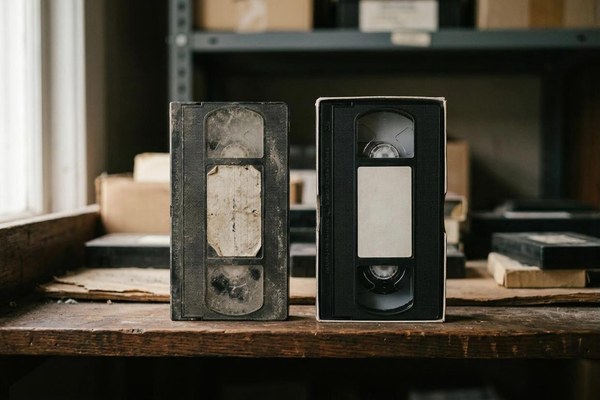
How Long Do VHS Tapes Last Before They Become Unplayable?
How Long Do VHS Tapes Last Before They Become Unplayable?
VHS tapes do not fail on a fixed birthday, but many family recordings become harder to trust after a few decades, especially if they have been stored in poor conditions. A well-kept tape may still play after 20, 30, or even 40 years. A badly stored one can become noisy, unstable, or jam-prone much earlier. So when people ask how long VHS tapes last before they become unplayable, the most useful answer is this: long enough to surprise you, but not long enough to justify waiting forever. The VHS to DVD UK homepage highlights a long-running specialist service for families across the UK, thousands of satisfied customers, professional transfer equipment, and a typical turnaround of 7 to 14 days. That matters when you are deciding whether to trust a tape conversion company with one irreplaceable cassette or a full box of family recordings.
If your aim is to preserve watchable access before age catches up with the archive, the most relevant next step is the core VHS to DVD conversion page. If backup matters just as much as playback, the related tape to MP4 page is also worth reviewing.
What affects VHS lifespan most
Storage conditions usually matter more than the calendar alone. A tape kept vertically in a dry indoor cupboard is far more likely to survive than one left in a damp garage, hot loft, or box by an outside wall. Repeated playback also matters. Every time a tape runs through a machine, it experiences friction and mechanical stress. That does not mean you should never watch old recordings, but it does mean that a tape used heavily over the years may age faster than a tape stored carefully and rarely replayed.
The playback machine matters too. A poor or dirty VCR can make a healthy tape look worse than it is. This is one reason families sometimes assume the tape is “dead” when the issue is actually the player.
A realistic lifespan guide
Use this as a rule-of-thumb rather than a guarantee:
| Storage history | Likely outcome | Priority level |
|---|---|---|
| Cool, dry indoor storage | Often still playable after decades | Important, but not immediate panic |
| Mixed storage with some loft or garage time | Increased risk of picture noise and tape drag | Convert soon |
| Damp, mouldy, or visibly damaged | Playback may be risky or already compromised | High priority |
| Frequently replayed family favourites | Wear may be noticeable even if stored well | Convert before more use |
The takeaway is simple: a tape can survive a long time, but longevity is not the same as reliability. A tape that technically still plays may already be losing quality compared with what it held years ago.
Signs a tape is getting close to failure
Watch for unstable tracking, weak colour, muffled or wavering audio, sticking during rewind, squealing noises, or visible residue in the cassette window. None of these signs automatically mean the footage is gone, but they do mean the tape should move up your priority list. If a tape is important and begins showing symptoms, repeated home playback is usually the wrong strategy. Your goal should be to capture the content while it is still recoverable, not to “get one more viewing” from the original cassette.
For sentimental family recordings, the risk of delay is often higher than the cost of action. Once the tape fails, no future price comparison matters.
Should you convert to DVD, MP4, or both before failure happens?
If your collection is still largely watchable, this is the ideal moment to convert because you can choose outputs calmly rather than in a panic. DVD is useful for simple viewing and sharing with less technical relatives. MP4 is better for backup, copying, and future flexibility. If you can only choose one output today, choose the one that best matches how your family will actually use the recordings. If you can choose both, that is often the strongest preservation decision.
In practical terms, the best time to convert VHS is while the tape is still playing, not after it has finally become unplayable. That is why lifespan questions are really timing questions in disguise.
Frequently Asked Questions
Can a VHS tape still work after 30 years?
Yes, many can, especially if they were stored well. But “still works” does not mean “safe to postpone”. Picture quality and playback reliability may already be slipping even if the tape has not failed completely.
Do unused tapes last longer than tapes that were watched often?
Usually yes. Lower playback wear can help, but storage conditions still matter enormously. A rarely used tape stored badly may be in worse shape than a frequently watched tape stored properly.
What is the best first step if I am unsure about tape condition?
Inspect the cassette visually, avoid repeated testing, and prioritise the recordings that matter most. If the archive includes irreplaceable family footage, conversion sooner is safer than waiting for clearer signs of failure.
Ready to protect your family memories?
If you want a current quote or want to see the service options in one place, visit VHS to DVD UK. You can compare formats, review the service, and take the next step before more ageing tapes become harder to recover.
